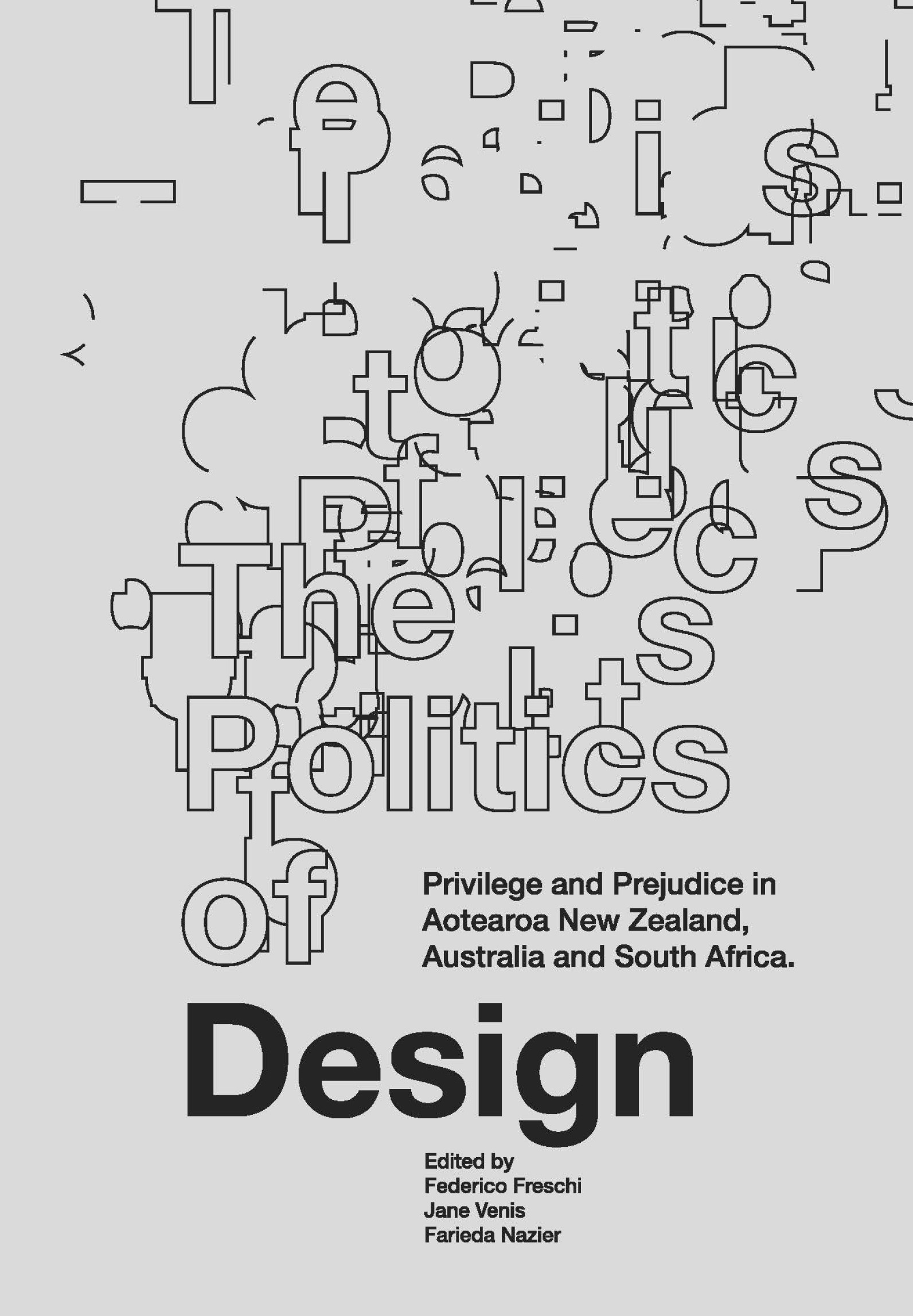
The Politics of Design - 2021
Privilege and Prejudice in Aotearoa New Zealand, Australia and South Africa
Published on 2021
https://doi.org/10.34074/book.647
Edited by
Federico Freschi
Jane Venis
Farieda Nazier
In Design as Politics, Tony Fry argues that in “giv[ing] material form and directionality to the ideological embodiment of a particular politics,” design must be understood as “profoundly political.”1 He argues further that all aspects of design that shape social and cultural experience – built environment, transport systems, information systems, infrastructure and so on – are by their nature ideologically loaded and “predicated on how human beings should be viewed and treated.”2 The longer arc of Fry’s argument is concerned with the urgent need to harness the political power of design to effect positive environmental change, a political transformation that he terms “Sustainment.” Nonetheless, his notion that “design expresses power materially and in ways that shape how people interact and ontologically prefigure their material culture”3 raises provocative questions about how design has historically served to distribute and exercise power.
In seeking to understand the causes and ongoing effects of global inequality, the relationship between design and politics deserves particular scrutiny in the postcolonial context. Despite being the product of deliberate political and social intentions, successful design appears ‘natural,’ its ideological biases effectively hidden in plain sight. In former settler-colonial societies, this ‘invisibility’ begs the questions of the historical complicity of design in imposing and maintaining racialised hierarchies of privilege, access, identity and notions of ‘belonging.’ While the former dominions of the British Empire in the southern hemisphere – Aotearoa New Zealand, Australia and South Africa – followed different paths to sovereignty, they are united by several common factors.
Compilation © Editors 2021
Chapters © Individual contributors 2021
Published edition © Otago Polytechnic Press 2021
Design © Matthew Galloway 2021
Images and figures © Copyright holdersISBN 978-0-908846-66-5 (Print)
ISBN 978-0-908846-67-2 (Online)